
Data management
Artificial intelligence
 •  
February 4, 2026

Agility is a capability problem, not a mindset issue

Zennify Team
By
Zennify Team

Financial institutions have poured trillions into technology and transformation, yet many banks and credit unions still struggle to keep up with rapid change. Despite spending more on IT than any other industry, they remain prisoners of legacy systems that hinder innovation.

What’s missing? In a word: agility. Not the buzzword version of “agile,” but agility as a strategic capability. The ability to pivot when plans don’t match reality. Unfortunately, this capability is exactly what most financial institutions have underinvested in, even as the ground shifts beneath them.

Agility: More than a mindset, it’s a capability stack

Too often, leaders talk about agility as a cultural mindset or a set of processes (think scrum teams and fail-fast culture). Culture is important, but true agility is built on a balance of hard capabilities. Zennify’s research calls this change appetite; the capacity to absorb disruption, adjust quickly, and keep the organization aligned amid uncertainty. 

Change appetite isn’t a vague philosophy, it grows through three concrete, reinforcing forms of agility:

  • Data Agility: The ability to turn information into action at the speed of change. This means having unified, high-quality data ready for decision-making,  not data trapped in silos or stuck in month-long reporting cycles.
  • Integration Agility: How fluidly your systems communicate and evolve. Can you plug in a new fintech API or cloud app without months of custom code? Or do brittle connections make every change a headache?
  • AI Agility: Readiness to deploy and scale AI and automation responsibly. It’s not just experimenting with chatbots or models, but integrating AI into processes in sync with data governance and core systems.

Each of these capabilities follows its own maturity curve from basic to advanced. Crucially, they must mature together. If one lags, overall agility suffers. For example, a bank might race ahead on AI pilots, but if its data is fragmented and integrations weak, those AI efforts will stall. Conversely, a modern data platform and API strategy without an AI-ready culture leaves innovation on the table. Agility is a systems capability, not just a mindset or a methodology.

Zennify's Agility Maturty Curve: Assessing organizational maturity across data, integration, and AI

The legacy investment trap

Why do so many institutions underinvest in agility? One reason is the legacy mindset, for decades, banks prioritized stability over flexibility. Operational tech was treated as a cost center rather than a strategic asset. The result is aging core systems and spaghetti integrations that eat budgets just to maintain. 

According to Gartner, over 75% of IT budgets in many banks are consumed by maintaining legacy systems, starving funds for innovation. In practice, that means new digital initiatives get the scraps, it’s no wonder so many digital projects under-deliver.

Consider that 63% of banks still rely on code written before the year 2000. Entire critical processes are running on COBOL and other pre-internet era code, often understood by only a couple of soon-to-retire employees. This isn’t just an IT headache; it’s a strategic crisis. When core infrastructure is this brittle, even small changes (a new product, a regulatory update) become massive undertakings. Decision-making slows to a crawl because teams are bogged down by manual workarounds and conflicting data from siloed systems. Leaders hesitate to pursue bold strategies when every move feels risky and resource-intensive.

Paradoxically, it’s not for lack of spending, it’s where the spending goes. Banks have funneled an estimated $2.8 trillion into digital transformation since 2011, yet still can’t meet customer expectations for seamless digital experiences. The lion’s share of that investment often goes into patching core systems and complying with regulations, rather than modernizing the underlying capabilities that drive agility. In effect, many institutions are paying a premium for inertia. They invest in “innovation theater” (shiny front-end apps, pilot projects) but neglect the foundational upgrades – enterprise data architecture, API-led integration, cloud analytics platforms – that would truly increase their responsiveness.

Strategic agility pays off

The institutions that do invest in agility as a capability are pulling ahead. Research bears this out: agile organizations (those that have built the technology and talent to adapt quickly) grow revenue 37% faster and generate 30% higher profits than their less agile peers. In fact, a global PMI study found companies with high organizational agility achieved 60% higher revenue and profit growth compared to low-agility organizations. That’s a massive performance gap, and it isn’t because one bank has smarter strategists than another. It’s because one bank can act on new information, trends, or risks immediately, while the other is stuck waiting on last quarter’s data from a half-dozen siloed systems.

Agility also shows up in risk management and customer retention. When COVID-19 hit or when fintechs launch new offerings, agile banks retool products or reallocate resources in weeks, not years. Less agile institutions watch opportunities pass or scramble frantically (and visibly) to catch up. 

  • Customer experience suffers when a bank can’t iterate digital features or even pull a 360° view of the client relationship. 
  • Operational risk rises when decisions rely on stale, error-prone data. In short, agility is a leading indicator of long-term performance. 

It’s the difference between being the disruptor versus the disrupted.

Crucially, agility is achievable with the right focus. It doesn’t require betting the bank on moonshot projects. It requires redirecting effort into the core enablers of speed and adaptability: cleaning up and unifying data, untangling integrations and embracing APIs, and building the governance and skills for AI-powered processes. 

As one banking CIO put it, “we had to stop guarding against change and start optimizing for change.” That means baking flexibility into systems and structures so that when the next punch comes (and it will), your institution can roll with it.

Building your change appetite

It’s time to treat agility as the most critical capability to invest in. This doesn’t mean abandoning prudent risk management or long-term planning, it means giving your teams the tools and freedom to respond when reality shifts. 

Every board agenda and budget should be asking: Will this make us more adaptive? If not, is it truly priority?

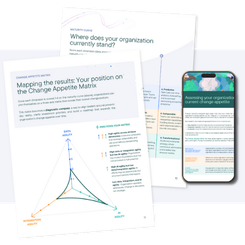
Zennify’s Change Appetite Matrix whitepaper

To learn more about building agility through balanced capabilities, download Zennify’s Change Appetite Matrix whitepaper. It provides a detailed framework for assessing your data, integration, and AI maturity, and practical steps to boost your change capacity. 

DOWNLOAD

$text$
$name$

$role$

Share this post
Facebook
LinkedIn