

Artificial intelligence
 •  
October 30, 2025

Insurance in transition: Transformative lessons from early FSC innovators

Zenn Team
By
Zenn Team

At Dreamforce 2025, Zennify CEO Chris Conant brought together a panel of insurance leaders and early adopters to talk candidly about what it takes to modernize the brokerage stack on Salesforce, specifically with the Financial Services Cloud for Insurance Brokerages (FSC for IB) solution, now enhanced by Salesforce’s Agentforce AI capabilities.

Melanie Muise, President of Personal Lines & Travel at Navacord; Matthew Watkins, CIO at IMA Financial; Michael Usiak, Director of Product Solutions & Strategy for Insurance at Salesforce; and Rich Levins, Insurance Principal Consultant at Zennify joined Chris for the discussion. 

While each came from a different vantage point, with both the Business and IT represented,  they shared one common belief: to scale, modernization in insurance is no longer optional. From replacing legacy AMS systems to redesigning how data, AI, and people work together, these leaders are proving that modernization isn’t about upgrading software, it’s about re-architecting the business for scale, speed, and client trust.

The modernization moment for insurance

The insurance sector is entering a decade defined by both expansion and disruption. Global brokerage revenue is projected to grow by more than 50% through 2030, driven by M&A and new embedded distribution channels. But that growth won’t be evenly captured, capability gaps will determine who wins.

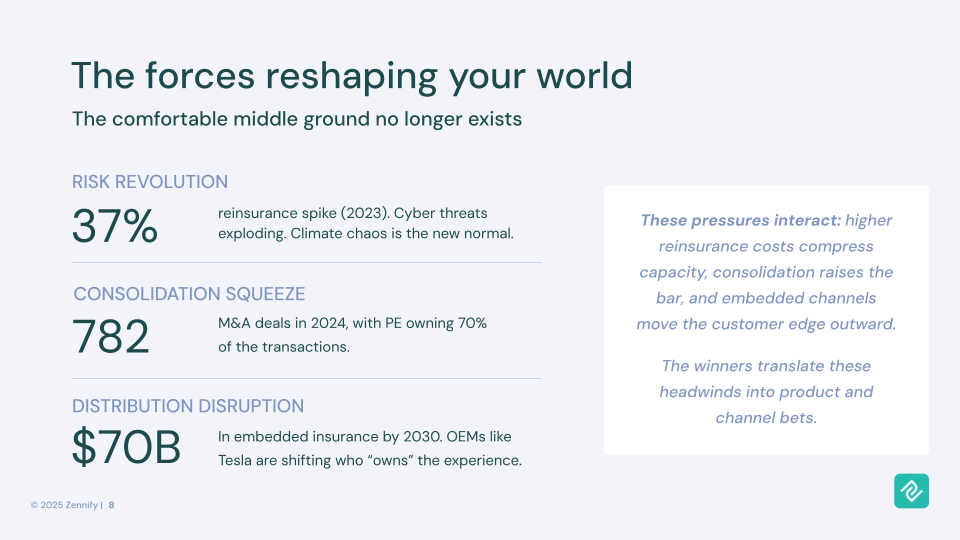
At the same time, structural headwinds are reshaping the market. Reinsurance rates rose an average of 37% in 2023, marking one of the hardest markets in decades. More than 780 M&A deals closed in 2024, with private equity accounting for about 70% of transactions. And by 2030, embedded insurance is expected to reach $70 billion globally. 

Add to that the rising cost of risk and an increasingly digital customer base, 67% of clients expect digital service, yet only 23% of brokers deliver it, and it’s clear why the comfortable middle ground no longer exists.

The panelists agreed: incremental change is over. The winners will be those who build flexible, connected platforms that drive faster innovation, regulatory alignment, and AI-powered client engagement.

From skepticism to success: how modernization really starts

For IMA Financial, modernization began with a mindset shift. “We started with one question, what business problem are we trying to solve?” said CIO Matt Watkins. The answer was clear: too many processes defined by legacy systems, and not enough flexibility to innovate.

IMA first documented how its Employee Benefits business should run, then chose a platform that could support it. Salesforce, even as a relatively new option for brokerages, offered that adaptability.

“We started with the business problem, not the technology, and built from there.”

— Matt Watkins, CIO, IMA Financial

Instead of running the project from IT, IMA empowered the business to define requirements and own decisions. The result: faster buy-in, clearer priorities, and a roadmap anchored in outcomes, rather than feature lists.

For Navacord, the journey began differently. “I was that person banging on the door saying, ‘I need a solution,’” said Melanie Muise, who led Salesforce adoption in the travel business to test, learn, and build momentum.

Their first implementation stumbled, too much customization, too little structure. Then Zennify came in, stabilized the project, and helped them build a real roadmap.

Modernization is as much about change management as technology.”

— Melanie Muise, President, Personal Lines & Travel, Navacord

That course correction reinforced one of the panel’s biggest lessons: modernization is as much about change management as technology. Success depends on setting the right scope, defining measurable goals, and bringing business users along for the journey.

A glimpse into the future: your “Agentic Enterprise” operating model

At Dreamforce, Salesforce introduced the Agentic Enterprise: a model where AI agents don’t just assist, they act. These agents automate multi-step tasks, surface insights, and make real-time decisions, freeing brokers to focus on clients, not admin.

In insurance sessions, Salesforce showed how Agentforce can already handle identity verification, renewal prep, and compliance steps in the background, all while syncing seamlessly with CRM data. The goal isn’t to replace people, but to amplify them. For brokerages, that means building platforms today that are ready for autonomous, AI-powered operations tomorrow.

Missed the announcements? Check out our blog: Top 5 Dreamforce 2025 announcements for financial services

Building adoption and realizing value

Both IMA and Navacord emphasized that adoption doesn’t happen automatically, it must be designed.

At IMA, a dedicated product owner and Salesforce team now manage the platform like an evolving product, not a one-time project. “We don’t want to rebuild every few years. We want continuous improvement,” Watkins said.

Navacord, meanwhile, learned the hard way that even the best technology fails without cultural alignment. “We’re used to buying tools but adoption can be a challenge,” Muise admitted. “We had to get really intentional about creating champions, training frontline users, and measuring usage.

Value realization, the group agreed, starts with measurable business levers. For IMA, it’s efficiency, reducing redundant data entry and freeing people to consult, not copy-paste. For Navacord, it’s revenue, boosting cross-sell across lines and lowering AMS license costs by moving more work into Salesforce.

Key lessons for insurers in transition

  1. Start with process, not platform. Define how your business should operate, then configure technology to support it.

  2. Deliver quick, visible wins. Focus on renewals or a high-volume line first to show impact.

  3. Treat adoption as a change program. Build champions, measure engagement, and celebrate time saved and renewals won.

  4. Design for data clarity. Establish what’s owned by CRM vs. AMS from day one, clean data is the backbone of AI and compliance.

  5. Iterate fast. Use product owners and agile sprints to evolve continuously instead of waiting for a “phase two.”

What this means for the industry

As insurers modernize, the dividing line is becoming clear: those that use AI, data, and platform automation to empower their people will outpace those who cling to legacy systems and fragmented workflows.

Agentforce is creating a new category, one where CRM and AMS converge, data drives service, and compliance comes built-in. But the real differentiator isn’t the technology, it’s the willingness to reimagine how work gets done.

“The firms that define their operating model, build around it, and keep iterating, those are the ones that will lead the next decade of insurance.”

— Chris Conant, CEO, Zennify

Ready to modernize your brokerage?

Zennify helps insurance leaders move from legacy systems to scalable, data-driven operations with Salesforce’s Financial Services Cloud for Insurance Brokerages and Agentforce.

Let’s map your modernization roadmap together.

$text$
$name$

$role$

Share this post
Facebook
LinkedIn