
Artificial intelligence
 •  
November 16, 2026

Forward deployed engineers in financial services, explained

Zennify Team
By
Zennify Team

You may have noticed that “Forward Deployed Engineers” (FDEs) are the newest line item in AI proposals to financial institutions. If you've wondered whether that's a new role or a new name for consulting, you're asking the right question.

To be honest, it's a bit of both. Some of the work will look familiar, and the engineer stays accountable for longer, through launch and into the months your staff and members rely on the agent. This article walks through what that looks like inside a financial institution, where the role helps most, and how to tell whether your program needs one.

What's a forward deployed engineer?

A forward deployed engineer (FDE) is a technical specialist who works inside your institution, alongside your operations, compliance, IT, and business teams. They design and build AI agents in your environment, using your data and systems. They’re also accountable for how the agent performs once your team and clients start using it.

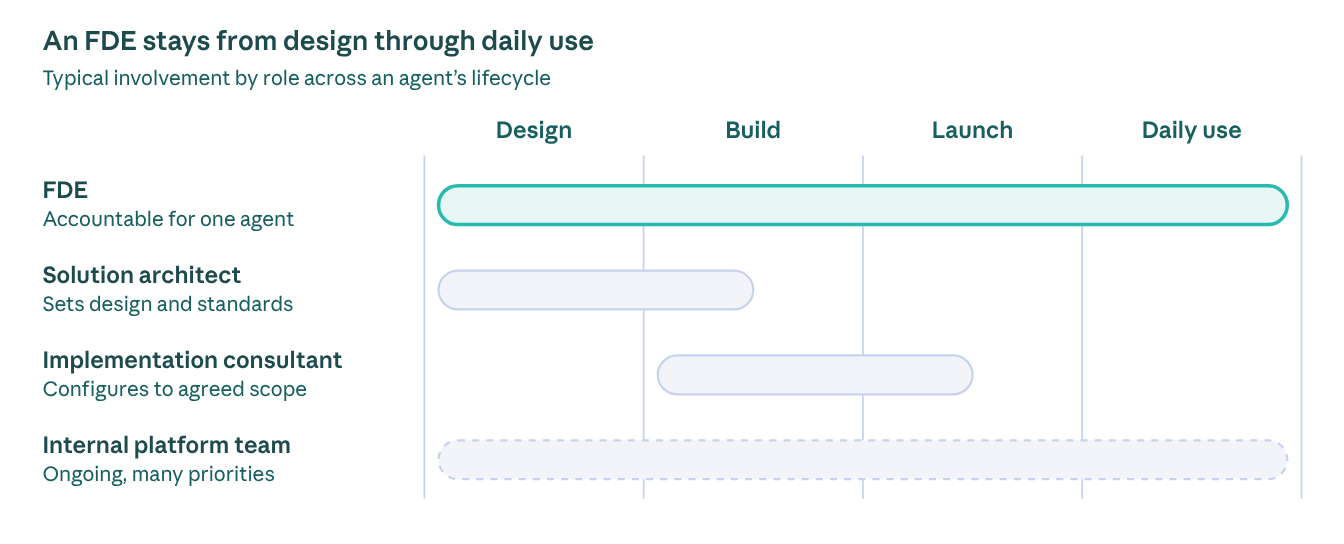
On a typical AI project, the work passes between several roles. A solution architect sets the design, an implementation consultant configures the platform, and an internal platform team runs it after launch. Each one covers a single stretch. An FDE stays with the agent from the first design decisions until it runs reliably in daily use. The diagram below shows how that compares.

‍

involvement by role across an agent's lifecycle

What they do, from design to daily use

Before anything is built

Much of the early work sets boundaries. An FDE maps what data the agent can see, what actions it can take (and can’t take), and where approvals and audit trails sit. They plan for your model risk, information security, and vendor management reviews from the start, so those teams assess a design built with them in mind.

Take a credit union building a member service agent. The FDE might let it answer balance and transaction questions, block it from moving money or changing account details, and log every conversation for review.

During the build

FDEs build against real scenarios in your actual systems, including the core, Financial Services Cloud, nCino, and your document repositories. They test the cases that trip agents up in banking, such as joint accounts, deceased members, disputes, and holds.

For a commercial lending team, that could mean an agent that summarizes a relationship's history before a renewal conversation. The FDE checks its output against real files, including the incomplete ones, before any banker relies on it.

After launch

Agents behave differently at volume, and the issues that matter tend to surface weeks after launch day. An FDE monitors how the agent performs, tunes it, and keeps the escalation path to a person working. They also define the controls your risk team will ask about, including what counts as abnormal behavior, who can pause the agent, and how an incident gets reported.

Throughout

An agent creates value only when people use it. FDEs work with the staff who rely on the agent to build trust and adoption, and with compliance to agree how its outputs are produced and reviewed.

Why FDEs are becoming the standard

AI agents don't behave like the software financial institutions are used to buying, and the way they're delivered is changing to match. After three years of building and deploying AI agents, we see five differences that make an embedded engineer the practical choice.

  • Agents keep changing after go-live. Their behavior shifts with your data, volume, and member requests, so someone has to keep tuning them.
  • Agents act inside your systems. Integrations, permissions, and audit trails only come together in your environment.
  • Building an agent is process design. Deciding when it hands off to a person takes someone who knows both the workflow and the code.
  • Pricing follows usage. With consumption and per-resolution pricing, an agent that underperforms costs you money.
  • Regulators expect a named owner. Yet in a 2026 Wolters Kluwer survey, 72% of US bankers said their bank was least prepared to shut down a malfunctioning AI model or report an AI failure.

Each of these continues after go-live, the point where a traditional implementation hands over. An FDE covers that gap, which is why the role is becoming standard in AI proposals. When you review one, ask who stays with the agent once it's live, how they'll monitor and tune it, and who your risk team calls when something goes wrong.

Does your program need a FDE?

The answer depends on how much risk and complexity your agent carries.

We recommend an FDE when your agent:

  • Touches customer or member financial data
  • Spans your core, CRM, and other systems
  • Faces model risk or third-party risk review
  • Talks to customers or members directly
  • Needs to run reliably at high volume

You may not need one when your agent:

  • Serves a small internal team with a contained use case
  • Works from non-sensitive data
  • Can launch with a standard implementation and your existing platform team

FDE support built for financial services

Zennify is a member of the Salesforce Forward Deployed Engineering (FDE) Partner Network, an invitation-only group of partners trained by Salesforce to deliver Agentforce and Salesforce related agents through AIForce. For your project, that means direct access to Salesforce product technical experts, faster escalation when an implementation issue comes up, and early access to new capabilities through the Salesforce Global Partner Agentforce Center of Excellence.

We pair that access with a focus on financial services. As a Leading Salesforce Consulting Partner for Financial Services, our teams know the cores, approval processes, and member expectations described above. See how we approach the full lifecycle in our Agentic Workforce solution.

Zennify is also Certified in the Claude Partner Network. For financial institutions, that means one partner can deliver on Agentforce and bring in Claude where it fits, such as document analysis and conversation intelligence.

Start with a clear view of your readiness

The right level of support depends on where your institution starts. Zennify's Digital Maturity Assessment benchmarks your AI readiness, data foundation, and governance, so you know which use cases you can take on now and what to strengthen first.

Request your free assessment >

$text$
$name$

$role$

Share this post
Facebook
LinkedIn