
Artificial intelligence
Data management
 •  
September 21, 2026

What financial services leaders actually talked about at Dreamforce

Zennify Team
By
Zennify Team

Wow, what a week! Just like that, another Dreamforce is done and dusted, and thank you to everyone who spent time with us. We hosted 600+ banking, credit union, wealth, and insurance leaders at the Zenn Lounge, and by Thursday afternoon we had logged hundreds of conversations. 

Almost none of them were about what AI can do. Salesforce had already made that case from the main stage, and nobody in the room needed convincing. What people wanted to talk through was everything sitting between a good idea and agents that return value and profit, which is exactly where the keynote landed too. 

“Two out of three financial services firms have AI stuck in pilot, and the cause is fragmented data and processes rather than model limits or a shortage of use cases.”

Here's what Salesforce announced, the argument underneath it, and what your peers said when the doors closed.

What Salesforce announced

AIforce, the live interface layer

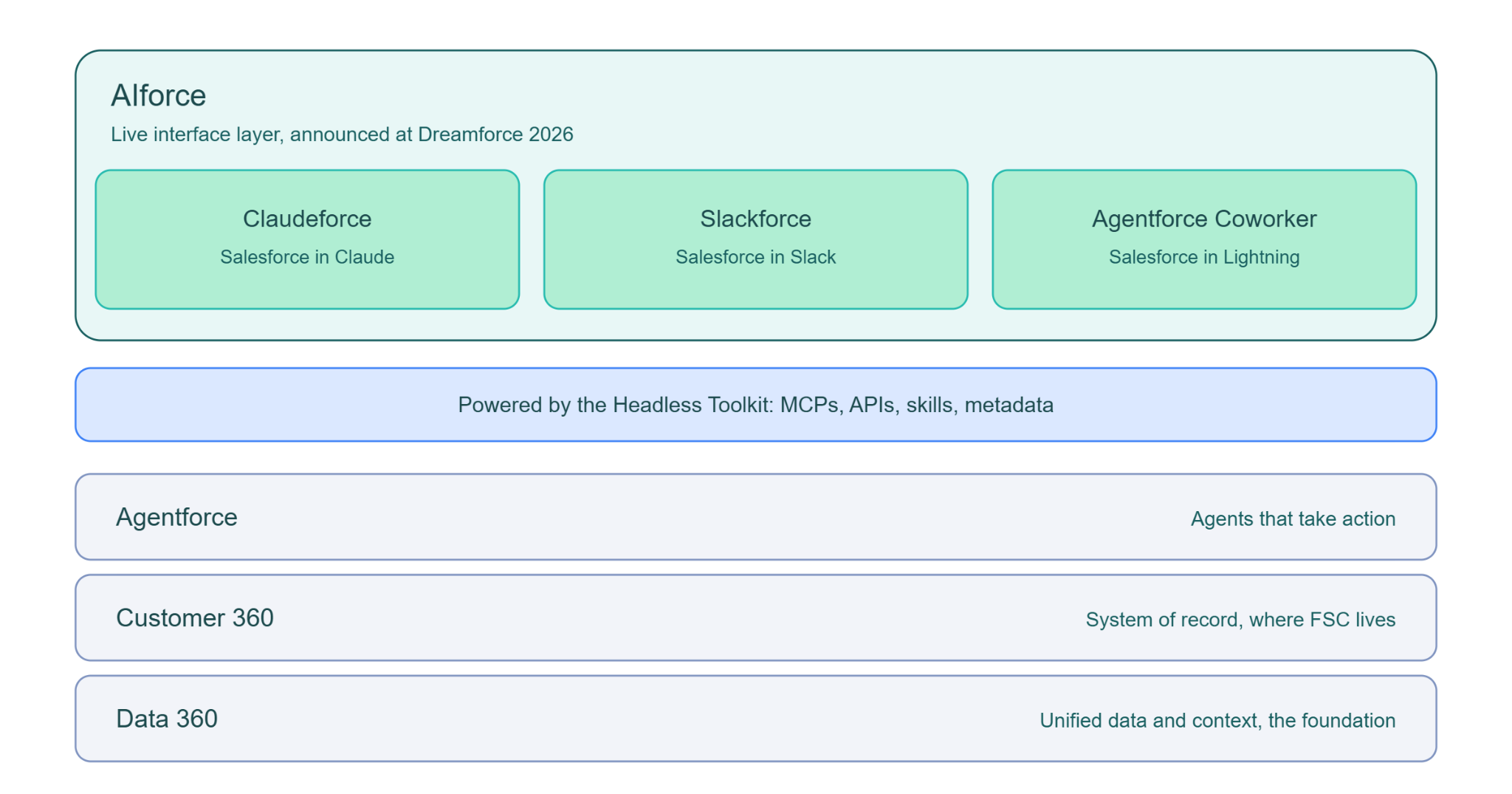
AIforce sits above Agentforce, Data 360, and Customer 360, and its purpose is to stop asking people to come to Salesforce. Your bankers and advisors can update records, trigger workflows, and ask questions from Claude, Slack, or Lightning, without opening a dashboard they have spent years avoiding. Every request still runs on the permissions and business rules you already set, so an agent sees only what the person using it can see. Marc Benioff called it an interface revolution, and Salesforce Ben has a good summary about the launch and what it replaces.

If you are a Microsoft shop, the relevant detail is that Teams is reachable through the Headless Toolkit rather than shipping as a named surface today. Salesforce built AIforce so that adding a surface is configuration rather than a build, which is the part to ask your AE about. 

Claudeforce and Salesforce in Claude

Claudeforce feeds Salesforce data and controls into Claude through a prebuilt connector, and it arrived with 37 ready-made sales skills. Slackforce does the same work inside Slack, while Agentforce Coworker sits in Lightning as a teammate that acts on someone's behalf. Salesforce reported that 100,000 people switched Coworker on in its first 35 days, a number worth watching if adoption is your usual bottleneck. Salesforce in Claude is now in open beta, and Michael Rouleau wrote a great summary about what this means for Financial Services.

Financial Services Cloud runs headless

Financial Services Cloud turns ten this year, and Salesforce spent the financial services keynote positioning it as the deterministic layer of your architecture, the place where KYC, onboarding, claims, and business rules live and behave the same way every time. It now runs headless, which opens its data and workflows to outside interfaces while the controls stay inside the CRM.

The demo made that more concrete. Claude walked an FSC instance, assembled a full client context, and updated records. When one configured process threw an error, Claude read the metadata, identified the problem, and proposed the fix. For institutions whose compliance posture depends on what the CRM enforces, that combination of an open surface and an unchanged guardrail is the part to take back to your architects.

If the naming is starting to blur, the nesting is simpler than it sounds. Data 360 holds the context, Customer 360 holds the record with Financial Services Cloud inside it, Agentforce is where agents get built and permissioned, and AIforce is where they show up, in Claude, Slack, or Lightning. The surface changes, the record and the rules underneath it do not, which is the part your risk committee cares about. 

Agentforce Operations goes after the process

Agentforce Operations is the process layer of the Agentforce family, and it’s new. Salesforce acquired it last year as Regrello, an AI-native tool built to turn unstructured business inputs into structured, agentic workflows, and rebranded it for Dreamforce. Rather than putting an agent on a screen, it takes the messy artifacts a process actually runs on, the emailed documents and attachments and handoffs, and rebuilds them into a coordinated flow that humans and agents work together.

In the onboarding example, documents arriving by email fed extraction, research, risk screening, and KYC, while staff kept the exceptions and the approvals.

Koa, a CRM-native model

Koa is Salesforce's first CRM-native reasoning model, built with NVIDIA on the Nemotron family and post-trained on CRM workflows like deal updates and case routing. The thesis is that a narrower, CRM-fluent model beats a general-purpose one on CRM-specific tasks. There is no proof yet and no word on cost, but it is a real bet on vertical model IP rather than riding someone else's foundation model, and it arrived alongside Gemini going generally available in the Agentforce Reasoning Engine. If you have already standardized on a model, the choice matters more to you than Koa itself.

What we heard firsthand from institutions 

Fragmentation runs deeper than the keynote suggested

The data problem is not one system away from being solved.

One large national bank runs more than a dozen Salesforce orgs, one per line of business, with no enterprise CRM strategy and no single view of platform risk. A diversified financial group described eight CRMs plus spreadsheets and no single customer list, and one of its divisions cannot create a lead because the org requires a member number that lives in a different division. At a credit union north of $20B, wealth runs on Salesforce while the rest of the institution runs another CRM, so staff carry referrals across by hand. A credit union CIO summed the problem up better than we could. His dirty data starts in the core, and a better warehouse will not clean it.

The firms making progress picked one journey and fixed identity there first, which is weeks of work rather than a program. 

Demand for headless arrived ahead of most security approvals

Your people want the assistant. Your CISO has not approved it yet. 

Requests for assistant demos, Claude pilots, and combined Claude and Salesforce workflows came up unprompted all week. One credit union already sorts its use cases by surface, sending member-facing work to Agentforce and internal work to the assistant layer. An RIA with ambitions of more than 20x its current assets runs Claude and Salesforce side by side today. For everyone else the constraint is the security review, and several firms running Microsoft and Teams told us their CISO has not yet approved the assistant their people are asking for. 

What moves that review is an evidence pack rather than another demo: what the agent can read, proof that every read runs as the signed-in user, what gets logged, and the retention terms in writing.

Governance turned into a buying requirement

Buyers now ask for governance up front instead of pushing back on it.

One large institution will not deploy an agent type until its agentic governance board signs off, and it wants that approval once per agent type rather than once per derivative, along with an agent registry, an audit trail, and usage reporting that proves adoption. Another bank had already built its own control plane to recommend models and track agents and cost. The question we fielded most often all week was how to govern 40 agents without reviewing each one individually.

That question has an architecture answer. A control plane spanning every layer, so you know who is using AI, which agents exist, and what data they touch, with each agent registered, risk-classified, and auditable from the day it goes live. Approve the pattern once and every agent after it inherits the approval instead of restarting the review.

Consumption turned into a governance question

The bill is an architecture decision, and most teams find that out late.

Credits and consumption forecasting came up in more conversations than we expected, and rarely from the finance seat. One Salesforce leader asked us directly how a governance program could predict consumption, which is the right question and not one most control planes answer today. The firms already running agents at volume were the ones asking, because they had watched a number move without being able to explain why.

Treat cost as a design input rather than a monthly report, and track it in the control plane next to the agent registry. Salesforce moved on this directly at Dreamforce, with Agent Fabric Wallets attaching a budget to an individual agent and tracking what it consumes through the month.

Consolidation gets funded as risk and payback

Nobody approves a tidying-up project. Plenty of people approve removing a risk. 

Centralization loses the political argument inside large federated institutions, and it has for years. One enterprise CRM owner moved his conversation forward by bringing a redundancy spend estimate, a payback period under five years, a first target of duplicate instances inside a single business line, and a low-cost like-for-like comparison on two branches before touching the rest of the estate.

Nobody funds centralization; plenty of people fund removing the risk of running one business line two ways.

The value case comes before the agents

Build the business case before you build the agent.

One mid-size bank won leadership attention with an efficiency case across about 200 operations staff worth $1.2M. Another institution admitted it commissions assessments and then shelves them. 

Affected headcount, loaded cost, and a conservative efficiency percentage gets you a defensible number in an afternoon, and the firms leaving Dreamforce with a 2027 roadmap built that number first, then planned to instrument the agent against it. 

Where to start in the next 90 days

So, you've left Dreamforce with a bag full of swag and 20+ new ideas. Here is how the pilot-to-profit gap actually closes: 

  1. Baseline the platform: Find out whether you have technical debt to clear before anything agentic goes on top. Start with a Digital Maturity Assessment and a Salesforce Health Analysis.
  2. Pick one process, not one agent: Onboarding, account opening, claims intake, and meeting prep all repeat often enough that saved time reaches a budget line and survives scrutiny. Pick the one with evidence behind it rather than the one people complain about loudest. Process analytics will show you where work actually stalls, how often, and how long it sits there, which gives you both the process to target and the baseline to measure against. We run this with Hubbl Process Intelligence.
  3. Design the context before the consumption: Your identity resolution and segmentation choices set your credit burn. Size them against the value you expect rather than discovering the relationship in month four.
  4. Stand up the control plane in parallel: An agent registry, an audit trail, cost tracking, and sign-off by agent type. That package is what gets a CISO to yes on a headless surface, and building it alongside the first use case costs far less than retrofitting it. Get started with yours here.

Where Zennify can help

You have the platform, the data, and the regulatory reality to work inside. We bring the data foundation, the governed AI layer, and the experience your customers touch, with 600+ Salesforce projects and 200+ data projects behind us.

If governance is the thing standing between your pilots and production, start with a Governance Advisory. We review the AI running across your institution today, assess it against your real use cases, and hand you a target-state architecture, a control-plane recommendation, and a technical roadmap. From there the path runs to activation in your own environment, then to a first governed agent live on the control plane with the data product behind it.

If you are earlier than that, our Digital Maturity Assessment scores your institution against a peer cohort at no cost, without touching your systems.

$text$
$name$

$role$

Share this post
Facebook
LinkedIn