
Artificial intelligence
 •  
September 22, 2026

How do you win when buying the best AI model is no longer the advantage?

Zennify Team
By
Zennify Team
banking-panel-dreamforce

AI model capability is converging. Stanford's 2026 AI Index puts six frontier developers within 25 points of each other on the Arena leaderboard, and concludes that competition is shifting toward cost and reliability rather than raw capability. 

So as the premier models now do roughly the same things at the same quality, what actually separates the institutions getting value from AI?

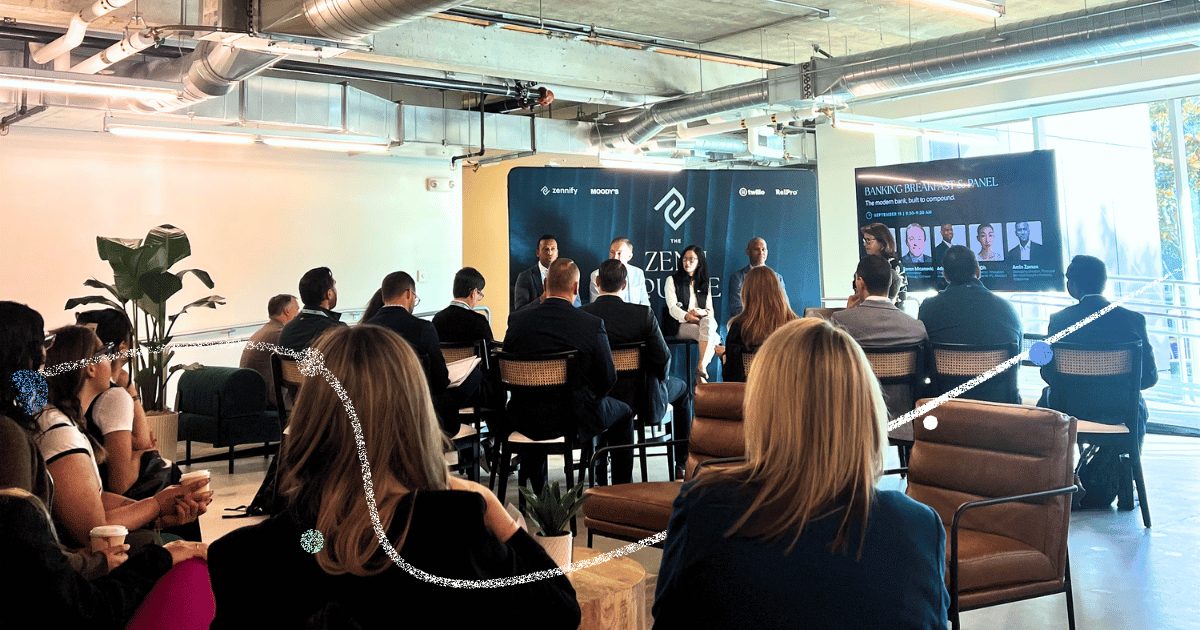
We put a version of that question to four leaders at our Dreamforce banking breakfast at the Zenn Lounge. Goran Micanovic, VP of Technology Development & Delivery at Compeer Financial, Adrian Glace, CTO at Amalgamated Bank, Jin Oh, Sr Director Innovation & GenAI at Moody's, and Amin Zaman, Managing Director Financial Services Industry Advisory at Salesforce.

They kept returning to the same idea. AI earns its keep when it shows up inside the work someone already does, and that takes three things:

  1. The right surface
  2. Data your people trust
  3. A reason to change how they work

The right surface

One panelist made the point by admitting something small. "I still write my passwords down. There are too many to remember." Then the follow-on. "So why would I ask a banker to open another application to get the insight?"

Every system you add is one more thing someone has to remember to go to.

Your banker's Tuesday has changed more than most roadmaps assume. Compliance and security requirements have grown steadily over the last five years, and the load shows up as checks, documentation and approvals sitting inside a banker's workflow. More of the morning goes to things that never touch a customer. Your customer now contacts the bank several times a year, usually for service, and arrives already knowing what they want.

"We used to swarm a customer the moment they walked in and sell them something," one panelist said. "Now I need to know what journey they've already been on before I open my mouth."

A banker with that morning won't go looking for an insight in a new place. Adoption dies right there, and everyone blames the technology or the team instead of the placement.

One panelist on the data side has built the principle into how they sell. They won't push clients to consume their agents or their data inside Salesforce or inside a lending platform. They listen for where the work actually happens and deliver there.

The same logic ran through Salesforce's announcements. AIforce exists so your bankers stop coming to Salesforce and Salesforce comes to them, in Claude, Slack, or Lightning, with your permissions and business rules running underneath. Financial Services Cloud now runs headless for the same reason, opening its data and workflows to outside interfaces while the controls stay in the CRM. We wrote up both in our Dreamforce recap.

One panelist pushed the point further. The premier models have converged enough that picking one is a commodity question, which puts the weight on everything around it. 

Put the intelligence inside the app where the work already happens. Then the time your team spends hunting for information turns into time spent acting on it.

Data your people trust

The right surface earns you the click. Trust takes more.

Every institution represented on that panel had more data than it realized. "You walk past it every day," one said. "You just don't know how to use it."

Retrieving data is the easy part. The work is organizing it, correlating it, and synthesizing it into what one panelist called decision grade intelligence. Agents rarely fail on reasoning. They fail on the data underneath them.

Governed data also costs less to run. When it's structured and accessible, you ingest it once rather than repeatedly, and you stop paying to reprocess the same records. That matters in a consumption model, where your identity resolution and segmentation design sets your credit burn before a single agent runs.

Get it right and your people stop double-checking the answer, because it came from sources they already trust with governance already in place. Skip it and you've moved the insight closer to them while handing them a reason to ignore it.

Change managed well

Right surface, trusted data, and the pilot can still die quietly.

At one institution the message came from the executive team and carried down to staff level, consistently, for months. They picked champions and trained them first so those people could teach everyone else. They celebrated what the champions achieved instead of just announcing a rollout. They collected feedback and acted on it.

"We were intentional about it," that panelist said. "We never assumed our employees wanted to do AI."

Another wouldn't wait for readiness. "You'll never have everyone ready. The education never stops, and people need to see what it does inside their own job." What surprised them was how quickly employees they'd written off as resistant came around.

All of that work is timing. You build appetite for months, and the platform has to be ready when it arrives. One panelist ran pilots that worked and caught executive attention, then built the enabling platform afterwards instead of alongside, which cost six to twelve months. Buyers now ask for the control plane up front for the same reason. Salesforce moved the same way at the event with Agent Fabric’s Model Wallets, which attach a budget to an individual agent inside MuleSoft's agent control plane. 

Where to start

“Ask what takes too long in your own day. Pick that, and start there,” a panelist closed with.

Friction makes the other two decisions for you. The screen is the one your people are already stuck in, the data is whatever that process runs on, and nobody needs convincing to fix something they've complained about for years.

The hard part is that the worst process is rarely the loudest one. Zennify's process intelligence analysis (powered by Hubbl Technologies) shows you where work actually stalls, how often, and how long it sits there, so you pick your first agent on evidence and have a baseline to measure against.

 Request your free process analysis > 

$text$
$name$

$role$

Share this post
Facebook
LinkedIn